
Around 100 members of the Al Ketbi tribe lived in this Sharjah desert village until the 1990s, and the sand has been filling their houses ever since. It is now a free, fenced site with a guard gate and a car park, about an hour’s drive from Dubai.
The part that trips people up is navigation. A direct map search for the village can route a car across open desert, while one road leads straight to the gate.
Al Madam Buried Village visit details
| Detail | Information |
|---|---|
| Village name | Al Ghuraifa (also called the buried village or Al Madam ghost town) |
| Location | Near Al Madam, in Sharjah’s Central Region |
| Entry | Free, no ticket or booking |
| Drive from Dubai | About 1 hour |
| Access | Guard gate and car park, reachable in a regular car |
| Facilities | None on site |
| Time needed | 1 to 2 hours |
| Best months | October to April |
| Built / left | 1970s / 1990s |
How to get there
Drive to the Madam Industrial Area junction on the E55, follow that road to its end, and turn right. The car park sits outside the gate.
The village lies south of Al Madam town, where the E44 (Dubai-Hatta Road) meets the E55 (Mleiha-Shwaib Road). That industrial-area road is the only one that reaches the gate.
- Drive to Al Madam. From Dubai it takes about an hour on the E44.
- Join the E55 and set your navigation to the Madam Industrial Area junction instead of the village pin.
- Turn off at the junction and follow the road straight to its end.
- Turn right and park outside the gate.
A search for the village itself can send you through soft sand, so the junction is the safer destination to enter.
Self-driving suits anyone with a car and a free half day. A tour suits anyone without a car, or anyone who wants a guide and a fixed pickup.
Regular car or 4×4
A regular car reaches the car park. The last stretch is not fully paved and is bumpy, but it needs no off-road driving.
A 4×4 only matters if you leave the road, and the soft sand around the village is where drivers get stuck. If you want to drive the dunes, book an operator who does it daily rather than trying it in your own car.
Tours
Private tours take about 4 hours from Dubai, Sharjah or Ajman, with hotel pickup in a 4×4 and around 2 hours at the village. Entry stays free, so the tour fee pays for the transport and the guide.
A tour removes the navigation and sand risk. The trade-off is a fixed arrival time, which matters if you want sunrise or sunset light.
Taxis & public transport
No public transport runs to the village. A taxi from Dubai or Sharjah works if the driver has the junction pin above and the return trip is arranged before you leave.
History of Al Ghuraifa
The village was built in the 1970s as a public housing project after the UAE’s formation in 1971. It housed around 100 members of the Al Ketbi tribe (also spelled Al Kutbi), a Bedouin group that had lived a semi-nomadic life, raising animals and moving between desert oases. They also visited Dubai and Abu Dhabi, which were then small port towns reliant on fishing and pearl diving.
Local details in the cement houses eased the move to settled life. Interior walls were painted in bright colours, and the homes had spaces where village leaders could host meetings.
A 2023 directive from the Ruler of Sharjah, Sheikh Dr Sultan bin Muhammad Al Qasimi, ordered the village preserved and prepared for visitors. The site now has fencing, a security gate, waste containers and a car park.
In 2025 the village was one of the venues of Sharjah Biennial 16, where works by Raven Chacon and Hugh Hayden were presented among the houses. A University of Sharjah team is also researching the site as a record of the UAE’s modern history.
Much older sites sit in the wider Al Madam area, including the archaeological sites of Al Thuqaibah and Jebel Buhais from the Iron Age and aflaj water channels dating back to the first millennium BC.
Why the village was abandoned
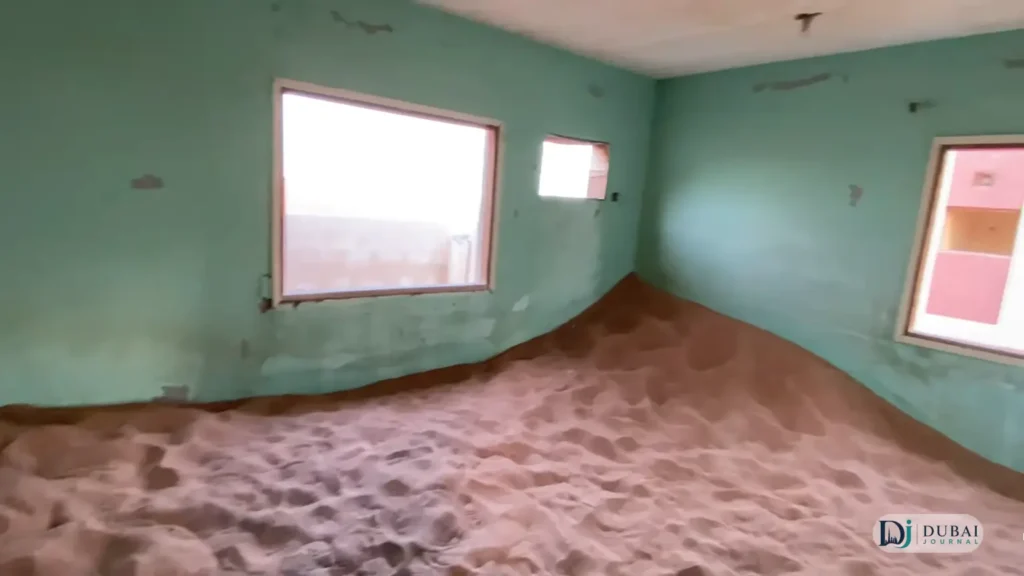
The families left in the 1990s, about two decades after the village was built, because living there had become harder than moving on. Several pressures stood behind the move:
- Sandstorms and drifting sand, which kept burying roads, including the ones to the village schools
- Limited electricity and water
- A long commute across the desert to government jobs and schools in Dubai
- Government-provided homes in nearby Al Madam town
Local folklore blames jinn, but former residents reject that explanation, and the practical pressures above account for the exodus.
What you can see
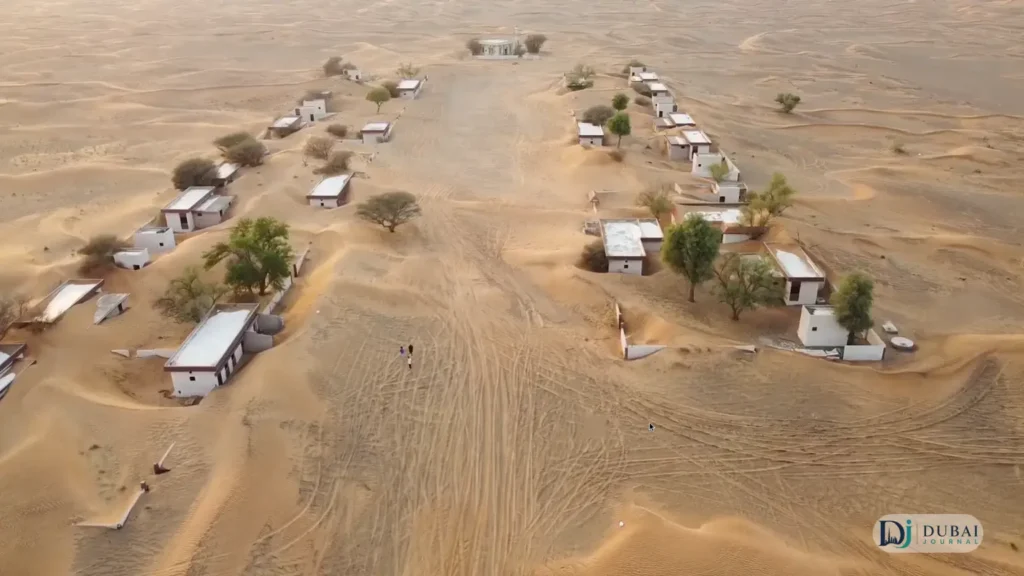
Two rows of identical houses and a mosque at the end of the road make up the village. Most of what is worth looking at is inside and around them:
- Interiors: some rooms keep blue, green and yellow paint or mosaic decoration, and one house has a wallpaper landscape of green trees on a wall.
- Sand: dunes have drifted through doors and windows, and in some rooms the sand reaches the ceiling, so you cannot enter them.
- The mosque: the best-preserved building, because workers from Al Madam sweep it clear regularly.
- Trees: a few scattered trees give the only shade.
Allow one to two hours. Low sun around sunrise and sunset picks out the dunes and the painted walls best.
Rules, safety & what to bring
Leave the walls as you found them. Earlier visitors left graffiti, scraped decoration off the walls and climbed on fragile roofs, which is why the fence and gate were added.
- Stay off roofs and walls. The buildings are weathered and unstable.
- Bring water and sun protection. There are no shops or drinking water on site, only the guard at the gate.
- Visit in daylight and plan to leave before sunset.
- Stay on the access road and car park. Soft sand starts beyond them.
Summer temperatures can pass 40°C with very little shade, which is the main reason timing matters.
Best time to visit
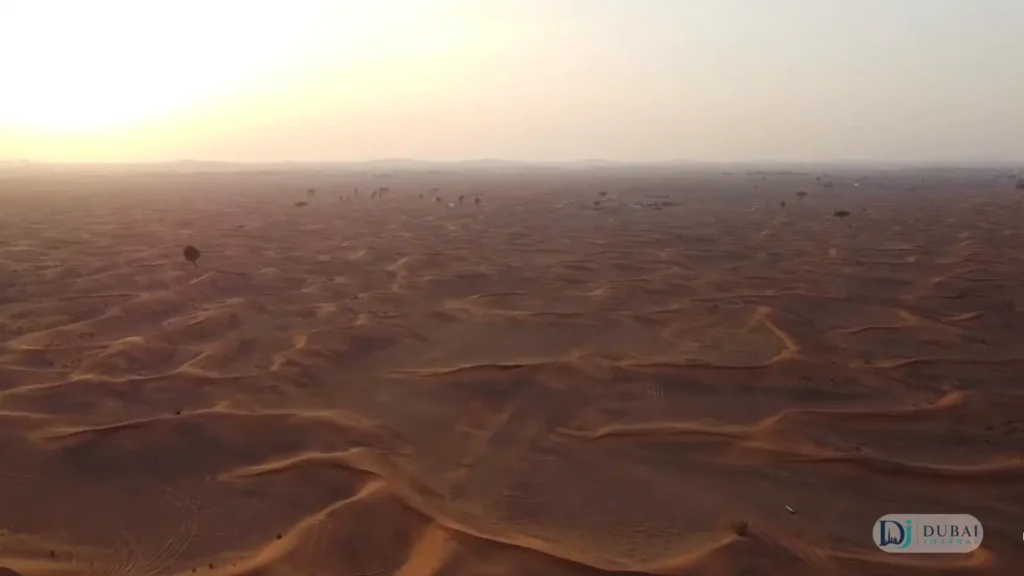
October to April is the comfortable window, with cooler air and gentler midday sun.
From May to September, go early in the morning. The few trees offer only small patches of shade, and the buildings hold heat.
Nearby stops
- Off Road History Museum: in Al Madam town, it holds the private collection of Sheikh Hamad bin Hamdan Al Nahyan of Abu Dhabi, built around off-road vehicles.
- Mleiha Archaeological Centre: around half an hour’s drive away, it covers the settlement history of the area.
- Sharjah Desert Park: on the Al Dhaid road, it adds a wildlife centre and a natural history museum to a longer day.
FAQ
Is Al Madam Buried Village the same as Al Ghuraifa?
Yes. Al Ghuraifa is the village’s own name. The buried village, Al Madam ghost village and Al Madam ghost town all refer to the same site near Al Madam town. Locals also call it Madam Old Town.
Is Al Madam Buried Village in Dubai or Sharjah?
Sharjah. It sits in the emirate’s Central Region, about an hour’s drive from Dubai.
Is Al Madam Buried Village free to enter?
Yes. There is no ticket or booking, only a guard at the gate.
Can you go inside the houses?
Many of the houses can be entered, though rooms where sand has reached the ceiling cannot. Stay off roofs and unstable walls.
How long does a visit take?
Plan one to two hours on site, plus about an hour each way from Dubai.
Is there public transport to the village?
No. You need a car, a taxi arranged for the round trip, or a tour with hotel pickup.
Is the village haunted?
Local folklore says jinn drove the families out. Former residents reject that, and sandstorms, limited services and a long commute explain why they left.
Next steps
- Save the Madam Industrial Area junction location before you leave, so the route does not depend on a live search at the turn.
- Pack water and sun cover for one to two hours without shops or shade.
- Add the Off Road History Museum or Mleiha Archaeological Centre to make the drive out worth a full half day.
